

*Image by Lapitec
Investing in new countertops is one of the biggest decisions you’ll make for your home, and sintered stone has quickly become the top choice for homeowners who refuse to compromise on durability or style. Before you place an order, understanding how this high-performance surface is built, what thickness options suit your space, and how specialized fabrication works will ensure you make a confident, seamless investment.
Core Focus
This guide is designed as a practical buying roadmap for homeowners, designers, and renovators considering sintered stone for their next project. Inside, we break down essential purchasing decisions—including raw mineral composition, key performance pros and cons, slab thickness options, and critical installation prep to ensure your cabinets and sub-surfaces are ready.
In This Guide:
This guide is part of our complete series. For an all-in-one guide to materials, costs, and comparisons, explore our pillar post: What Is Sintered Stone: A Comprehensive Overview →
Sintered Stone Countertops What You Need To Know Before Buying
1. Understanding Sintered Stone: Material Composition & Quality Factors
The Natural Mineral Recipe
Unlike traditional engineered stone surfaces that rely on acrylic or polyester resin binders, sintered stone is crafted entirely from 100% natural, raw minerals. Its recipe consists primarily of three ingredient groups:
Raw quartz particles which give it its extreme hardness
Glass minerals for structural stability
Fine porcelain clays to deliver consistent strength and colour depth
Because the formula contains zero synthetic polymers, volatile organic compounds (VOCs), or chemical additives, the material remains entirely eco-friendly, non-toxic, and resistant to chemical degradation over time.
The Sintering Process
Sintered stone is made by using extreme pressure and heat to turn natural minerals into a strong, solid slab. The process is similar to how natural stone is formed deep within the earth, but instead of taking thousands or millions of years, it happens in just a few hours.
First, the raw minerals are ground into an extremely fine powder. The powder is then compressed under more than 25,000 tons of pressure, removing gaps between the particles and creating a very dense material.
Next, the material is heated in specialized kilns to temperatures of up to 1,200°C (2,200°F). The intense heat causes the mineral particles to bond together, creating a solid, durable slab with very low porosity.
The Sintering Process
Raw Minerals
Natural mineral materials are selected and prepared for transformation.
Ultra-Fine Powder
The raw materials are pulverized into an extremely fine powder.
Extreme Pressure
More than 25,000 tons of hydraulic pressure compresses the material and eliminates internal voids.
Extreme Heat
The compressed material is fired in specialized kilns at temperatures up to 1,200°C (2,200°F).
Sintered Stone
Heat fuses the particles together at a molecular level, creating a dense, highly durable slab.
Raw Minerals Transformed Into a Solid Surface
A manufacturing process that accelerates the natural stone-forming process from thousands of years into hours.
Key Surface Characteristics
The sintering process creates a dense, non-porous surface that is highly resistant to moisture, stains, and everyday messes.
Dense, Non-Porous Surface
Extreme heat and pressure create a tightly compressed material with very little space for liquids or contaminants to enter.
Extremely Low Water Absorption
With water absorption below 0.05%, spills such as coffee, wine, oil, and citrus juice have little opportunity to soak into the slab, helping prevent deep stains.
Easy-to-Clean, Hygienic Surface
Because the surface has very few pores, it provides little opportunity for bacteria, mould, or mildew to penetrate. This makes sintered stone easy to clean and well suited to kitchens, bathrooms, and other areas where hygiene matters.
2. Pros & Cons of Sintered Stone Countertops

*Image by Lapitec
The Advantages (Pros):
Sintered stone countertops offer you many great benefits. Here are just a few.
Great Durability
Sintered stone countertops are built to last, making them the perfect choice for heavy-traffic areas and busy kitchens. Throughout the sintering process, the countertop's surface becomes ultra-dense and super-resistant to cracks, chips, and scratches, and thus your countertop will be immaculate for decades. Compared to natural stone, which is fragile against breaks, sintered stone has the ability to keep its strength even when put through heavy usage and remains a stable choice for commercial structures and families.
Heat and Stain Resistance
One of the most noticeable strengths of sintered stone is its unparalleled heat resistance. Whereas quartz will burn or change colour when subjected to direct heat, sintered stone remains unchanged by high temperatures. This also means resistance to staining, so hot pots and pans can be placed on the surface directly without harm.
Also, sintered stone is totally non-porous, a barrier to stains from food, wine, coffee, and domestic chemicals. Unlike granite or marble, which need to be sealed every so often to avoid staining, sintered stone retains its resistance naturally, making it a low-maintenance choice for homeowners.
Eco-Friendliness
If sustainability is of importance to you, sintered stone is among the greenest countertop materials on the market. Sintered stone is produced using natural minerals and no synthetic resins or binders, so the product is non-toxic and environmentally sustainable. The process of manufacturing it is energy efficient with low waste and emissions, less than many other engineered surfaces.
Moreover, sintered stone is 100% recyclable, which means it can be reused upon its life cycle completion rather than sent to landfills. Its low carbon emission and sustainable origin make sintered stone a fantastic choice for homeowners who want to make environment-friendly decisions within their home interior design.
The Trade-Offs (Cons):
Sintered stone countertops are a great option for many people, however, there are some factors that you need to take into consideration before deciding whether or not they are the right option for your home.
Higher Price
Sintered stone is a premium material, and the price tag for it reflects the sophisticated technology and process used in developing it. Sintered stone is pricier than material like laminate or some of the quartz material, so you may feel that it is too much for your budget. As much as longevity and durability may offset the expense eventually, the initial cost may be too high if you are watching your pennies.
Hard To Repair
Despite its great durability, sintered stone is not damage-proof. If a countertop cracks or chips, it can be hard and costly to repair due to the hardness and density of the material. Unlike natural stone, where resin or filler can sometimes revive it, sintered stone must be subjected to special restoration methods. In extreme damage, replacement is the only option, so careful use and professional installation are necessary.
Few Edge Profile Options
As compared to quartz and natural stone, sintered stone provides less scope for edge profile customization. Due to the fact that it is ultra-dense, detailed or elaborate edges are difficult to create, and design choices are limited for homeowners looking for very ornate countertops. Plain and minimalist edge profiles like straight, beveled, or eased edges can be achieved, but homeowners who look for detailed or rounded profiles may find sintered stone less versatile than granite or quartz.
Specialized Installation Required
Sintered stone is an extremely heavy and hard material, hence it is more difficult to cut and install compared to other countertops like granite or quartz. Due to its brittleness prior to installation, it can crack or shatter when handled. For this reason, expert installation is highly recommended for precise cutting, proper support, and seamless integration. Expert installers have the necessary special equipment and expertise to handle sintered stone safely and effectively.
3. Choosing the Right Slab Thickness & Profile

*Image by Marble Trend
When choosing sintered stone, thickness is about more than appearance. The right thickness depends on where the material will be used, the look you want, and how the edges will be finished.
Choosing the Right Thickness
6 mm (¼") — Lightweight Applications
This is a thinner option that works well when you want the look of sintered stone without the weight of a full countertop slab.
Common uses include:
Wall cladding
Backsplashes
Cabinet or furniture overlays
Other vertical applications
12 mm (½") — Sleek, Modern Countertops
This is a popular choice for a clean, contemporary countertop look. Its slimmer appearance works particularly well in modern kitchens and bathrooms.
Creates a streamlined, European-inspired appearance
Works well with contemporary designs
Can provide the look of a substantial countertop without a thick edge
20 mm (¾") — A More Substantial Look
This is a thicker option if you prefer a more traditional countertop appearance.
Creates a solid, substantial edge
Well suited to traditional and transitional kitchens
Can provide a finished thicker edge without relying on a built-up edge
Choosing an Edge Profile
The edge of your countertop can have a surprisingly big impact on its overall appearance. Sintered stone can be fabricated with several edge styles, depending on the slab and installation.
Common options include:
Square Edge: Clean and straight for a modern, minimalist look.
Ease Edge: A slightly softened edge that reduces the sharpness of a square corner.
Chamfered Edge: A small angled cut that adds a subtle design detail.
Mitered Edge: Two pieces are joined at an angle to create the appearance of a thicker countertop.
The best combination of thickness and edge profile depends on your specific slab, design, and installation. A qualified fabricator can recommend the right approach based on the material and the look you want to achieve.
4. Important Considerations Before Ordering
Sintered stone is extremely durable, but a successful countertop installation starts with proper planning. Before ordering your slab, there are a few important details to discuss with your fabricator and installer.
Make Sure Your Cabinets Are Ready
Your cabinets need to provide a strong, stable, and level base for the countertop.
Before installation:
Cabinets should be properly levelled and securely installed.
The supporting surface should be flat and suitable for the slab.
Where a plywood substrate is required, it should be properly installed and supported.
Avoid uneven areas or gaps that could create pressure points under the slab.
A properly prepared base helps distribute the weight evenly and reduces unnecessary stress on the countertop.

*Image by Natural Stone City
Plan Your Overhangs
Island and breakfast-bar overhangs need to be planned carefully. The amount of unsupported overhang depends on factors such as the slab thickness, cabinet layout, and installation method.
Before finalizing your design:
Ask your fabricator how much overhang your chosen slab can safely support.
Discuss whether additional support, such as brackets or corbels, will be required.
Consider support requirements early, especially when designing large islands or seating areas.
Think About Seam Placement
If your countertop requires more than one piece of slab, the location of the seams should be considered during the design stage.
Your fabricator can help determine the best locations based on:
The size and shape of your countertop
The location of sinks and cooktops
High-use areas
The pattern and veining of the slab
Whenever possible, seams should be planned in locations that make sense visually and avoid unnecessary stress or moisture exposure.

*Image by Natural Stone City
A Little Planning Goes a Long Way
Choosing the right thickness, preparing the cabinets properly, planning overhangs, and discussing seam placement before fabrication can help ensure your sintered stone countertop looks great and performs as intended for years to come.
5. What to Expect During Fabrication & Installation
Once you have chosen your sintered stone slab, the next step is turning it into a countertop that fits your space precisely. Because sintered stone is extremely dense and hard, specialized equipment and experienced fabrication are important to achieving a quality finished result.
The Importance of Specialized Equipment
Sintered stone requires specialized equipment and techniques for accurate cutting and finishing. The quality of the equipment your fabricator uses can make a difference when working with complex cuts, sink openings, corners, seams, and detailed designs.
When choosing a fabricator, it is worth asking what equipment they use to cut and finish sintered stone. Advanced cutting technology can give experienced fabricators greater control and precision while helping reduce the risk of chipping or damaging the slab.
For example, Natural Stone City uses a Breton Trinity cutting machine, an advanced CNC system designed for precision stone fabrication. Having advanced equipment in-house allows experienced fabricators to accurately translate a carefully measured design into the finished countertop pieces.
The takeaway is simple: choosing a quality slab is only part of the process. The experience of your fabricator and the equipment they use are also important considerations.
Specialized Cutting & Finishing Tools
Sintered stone is very hard and requires the right tools to cut and finish properly.
Fabricators may use diamond-tipped cutting tools and waterjet technology to create precise cuts while helping minimize the risk of chipping or damage.
Experienced fabricators also understand how different sintered stone products respond during cutting, edge finishing, drilling, and handling.
This knowledge is particularly important for detailed designs or areas requiring multiple cuts.
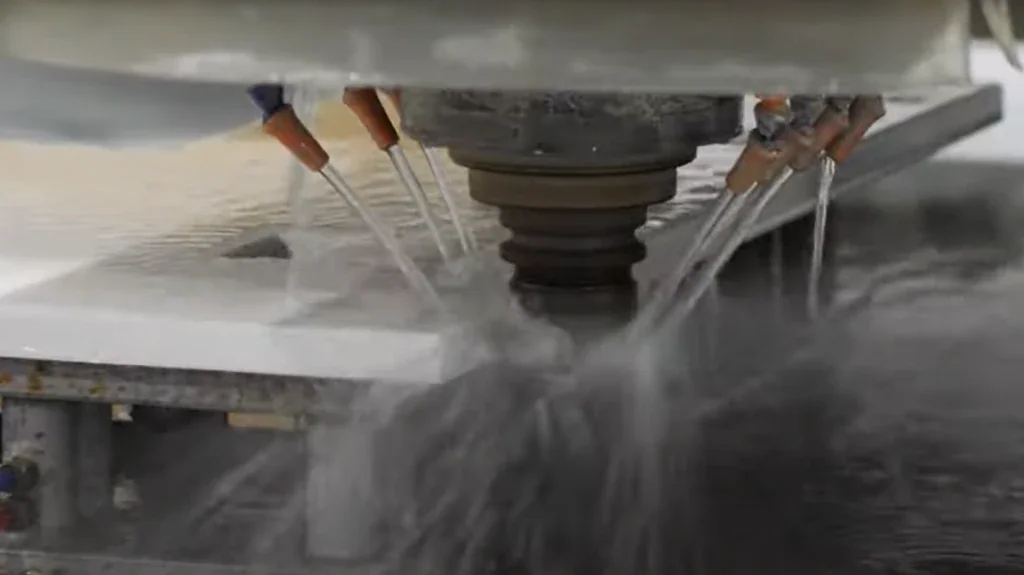
*Image by Natural Stone City
Precise Measuring & Digital Templating
Before the slab is cut, your fabricator needs an accurate measurement of your space. Digital laser templating can create a precise template of your cabinets, walls, sinks, appliances, and other important features.
Accurate templating helps the fabricator:
Achieve a precise fit around walls and cabinets.
Position sinks and cooktops correctly.
Plan seam locations before cutting begins.
Account for walls or cabinets that may not be perfectly square.
Reduce the risk of costly cutting errors.
This step is especially important with sintered stone because once the slab has been cut, changes are difficult or impossible to make.
From Template to Installation
After the template is completed, the measurements and design are used to plan the cuts and fabricate the individual countertop pieces. The finished pieces are then prepared for delivery and installation.
The exact timeline can vary depending on slab availability, project size, design complexity, the number of pieces required, and the fabricator's schedule. Your fabricator should be able to provide a more accurate timeline once your slab has been selected and the project has been measured.
What This Means for You
A high-quality sintered stone countertop is the result of more than choosing a beautiful slab. Accurate measurements, advanced equipment, skilled fabrication, and careful installation all play a role in the finished result.
Before choosing a fabricator, ask about their experience with sintered stone, the equipment they use, how they handle templating and fabrication, and what you can expect during the installation process.
6. Cross-Links to Related Sintered Stone Guides
Conclusion & Final Verdict
Choosing sintered stone is one of the most rewarding investments you can make for your home, but achieving a flawless result comes down to proper planning. Understanding slab specifications, from selecting the right thickness for your application to choosing edge profiles that suit the material's ultra-dense structure, ensures your countertops look stunning and perform reliably for decades. Because sintered stone requires specialized cutting tools and precise handling, partnering with an experienced, certified fabricator and installer is the single most important step in turning your design vision into reality.
See Full Sintered Stone Slabs in Person
Bring your vision to life by visiting our local showrooms. Experience full-scale slabs under natural light, explore custom finish options, and consult with our local fabrication and installation experts.
What Homeowners & Pros Say About Working With Us
"Natural Stone City provided top notch service and quality. From the first time we walked into the showroom through to final installation, they went above and beyond to ensure that their costumer is not just satisfied, but truly happy with their investment...Go visit them, you will not be disappointed!"
"Super happy with the result and also with the experience we had with Natural Stone City team. Easy to order, very helpful and experienced team members, 3 hours installation. Pictures speak for themselves.Thank you!"
"As a local contractor Never an issue with this company been with them for 10+ years. Always been well taken care of with all of their staff with the right prices for a quality job. Highly recommend."