
Sintered Stone Maintenance & Care: The Complete Guide
*Image by Cosentino
Countertop maintenance can easily feel like a full-time job, from managing routine sealing schedules for granite to constantly worrying about acidic etching on marble or hot pans scorching quartz. Sintered stone changes the equation entirely, leveraging an advanced, resin-free mineral composition to deliver a high-performance surface that is virtually impervious to daily wear.
Core Focus
This guide provides a comprehensive breakdown of everyday maintenance, cleaning strategies, and protective best practices for sintered stone countertops. Learn how to handle routine wipe-downs, eliminate stubborn spills, care for specialized surface finishes, and protect exposed edges, all while taking full advantage of a non-porous material that never requires sealers or high-maintenance care routines.
In This Guide:
This guide is part of our complete series. For an all-in-one guide to materials, costs, and comparisons, explore our main pillar guide: What Is Sintered Stone: A Comprehensive Overview →
Sintered Stone Maintenance & Care
1. Daily & Routine Cleaning Best Practices
Sintered stone is designed to be a low-maintenance surface, and most everyday cleaning can be handled with a few simple supplies and consistent habits. The key is to use gentle cleaning methods that keep the surface looking clean without leaving behind streaks or residue.
Everyday Cleaning Essentials
For routine wipe-downs, you generally do not need specialized stone cleaners. A simple combination of warm water, mild dish soap, and a soft microfiber cloth is effective for removing everyday dust, crumbs, fingerprints, and light spills.
Mix a small amount of mild dish soap with warm water.
Wipe the surface with a soft microfiber cloth to remove everyday dirt and residue.
Use a clean section of the cloth when necessary to avoid spreading debris across the surface.
For routine maintenance, cleaning the surface regularly is usually preferable to allowing residue to build up.
Surface Finishes Matter
The basic cleaning approach remains the same across sintered stone finishes, but the way you wipe the surface may vary slightly depending on its texture and appearance.
Polished finishes have a smooth, reflective surface that can make fingerprints, smudges, and streaks more noticeable. A soft microfiber cloth is particularly useful for removing these marks and leaving the surface looking clear.
Matte, textured, or brushed finishes may have more surface variation, so cleaning should follow the direction or contours of the finish where applicable. Rather than simply wiping across the surface, take care to work the microfiber cloth into textured grooves or areas where dust and residue may collect.
Rinsing & Drying
After cleaning with soapy water, rinse the surface with clean water and dry it with a soft microfiber cloth. This simple extra step helps remove remaining soap residue and minimizes water spots and streaks.
Rinsing and drying are especially helpful on dark-coloured or high-gloss sintered stone, where dried water droplets and cleaning residue can be more visible.
Tailoring Your Routine to Your Surface Finish
Polished / High-Gloss
Microfiber drying is essential after wiping to prevent visible water spots and streaks on mirror-like surfaces. Avoid harsh abrasives that could dull the high-gloss shine over time.
Matte / Satin
Naturally resists fingerprints and smudges exceptionally well. Wipe standard spills with warm, soapy water using smooth, circular motions for a clean, consistent look.
Textured / Slate
Requires attention along textured contours. Use a soft-bristled brush or damp microfiber cloth along the grooves to lift settled flour, dough, or dried food particles.
2. Stain Removal & Deep Cleaning Strategies
Sintered stone’s non-porous, resin-free composition makes it resistant to many common stains, but stubborn spills and deposits may still require more targeted cleaning. The goal is to loosen the residue without relying on harsh abrasives that could affect the surface finish.
Handling Stubborn Spills
Dried grease, wine, coffee, and strongly coloured foods can leave visible residue if they are allowed to dry on the surface. Start with a mild cleaning solution and a soft cloth, allowing the cleaner a little time to loosen the residue before wiping it away.
Dried grease: Use warm water with mild dish soap to break down the grease, then wipe the area with a soft microfiber cloth.
Wine and coffee: Apply a mild soap solution and gently wipe the affected area rather than using abrasive scouring products.
Food dyes: Clean the area with a gentle surface cleaner and soft cloth, repeating the process if necessary rather than scrubbing aggressively.
Avoid harsh abrasives or abrasive pads when treating stubborn spills, as unnecessary abrasion can affect the appearance of certain finishes.
Dealing with Hard Water & Limescale
Hard-water deposits and limescale can build up around sinks, faucets, and other areas that are frequently exposed to water. For these deposits, a mild acidic cleaner, such as diluted vinegar or a gentle descaler suitable for the surface, can help dissolve mineral buildup.
Apply the diluted cleaner to the affected area, allow it to work according to the product directions, and then wipe the surface clean. Unlike acid-sensitive natural stones, properly selected acidic cleaners can be used on sintered stone without etching or dulling the material.
Paint, Ink, or Adhesive Removal
Paint, ink, and adhesive residues may require a solvent rather than a conventional soap-and-water cleaning solution. Because sintered stone has a non-porous, resin-free surface, appropriate solvents such as isopropyl alcohol or acetone can be used to help remove these substances without damaging the material.
Apply the solvent carefully to the affected area and wipe away the loosened residue with a soft cloth. Avoid using abrasive tools to scrape away the remaining material, particularly on polished or other highly finished surfaces.
Cleaning Quick-Reference Guide
Use this reference table for instant recommendations on handling everyday spills, stubborn residues, and specialized cleaning scenarios:
| Mess Type | Recommended Cleaner | Application Method | What to Avoid |
|---|---|---|---|
| Everyday Crumbs & Spills | Warm water & mild dish soap | Soft microfiber cloth | Dry scrubbing |
| Dried Grease & Oil | Warm water + degreasing soap | Soft sponge, let sit 2 mins | Abrasive scouring pads |
| Hard Water & Limescale | Diluted white vinegar or gentle descaler | Spray, wipe, & rinse thoroughly | Concentrated industrial acids |
| Paint, Ink, or Adhesive | Isopropyl alcohol or acetone | Dab with soft cloth, then rinse | Metal blades / harsh scraping |
3. Heat, Scratch, and Chemical Resistance Limits
Sintered stone is engineered to withstand demanding everyday conditions, including high temperatures, sharp objects, and many household chemicals. However, understanding the practical limits of these properties helps protect both the surface and the items used on it.
Direct Heat Tolerance
Sintered stone has exceptional resistance to heat because it is manufactured from mineral materials fused under extremely high temperatures.
As a result, placing a hot or scorching pan directly on the surface will not normally burn, scorch, or discolour the material.
Even with this high heat tolerance, thermal shock precautions are recommended around seam points.
Avoid subjecting a seam to sudden and extreme temperature changes, as localized thermal stress can affect the installation even when the sintered stone itself is highly heat resistant.
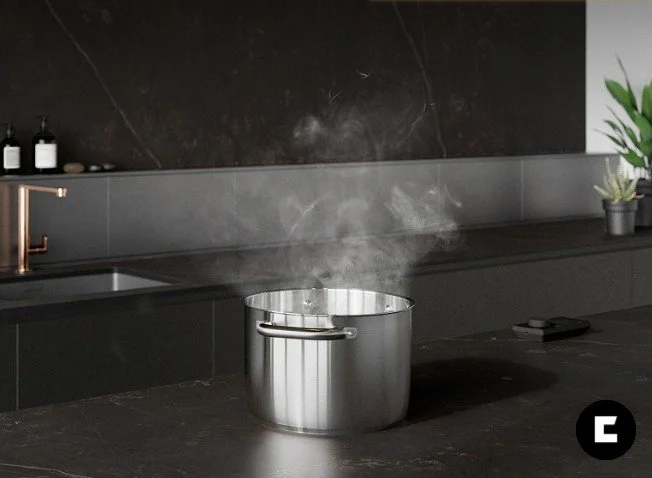
*Image by Cosentino
Cutting & Chopping
Sintered stone offers extreme scratch resistance, making it highly resistant to marks from everyday kitchen use. However, a cutting board is still recommended when chopping or slicing directly on the countertop.
A cutting board protects your knife blades from the much harder sintered stone surface, which can quickly dull or damage the edge.
Using a cutting board also provides a more appropriate work surface for cutting, allowing knives to maintain their sharpness while keeping the countertop available for food preparation.
Chemical Immunity
Sintered stone has a high level of resistance to many household chemicals, including bleach and acidic substances. Its dense, non-porous, resin-free composition does not react with these substances in the same way that acid-sensitive natural stones can.
For comparison, acids can etch marble almost immediately and can also damage or etch susceptible granite surfaces. Sintered stone provides substantially greater chemical resistance, making it well suited to areas where household cleaning products or acidic substances may come into contact with the surface.
4. Do You Need to Seal Sintered Stone? (The Zero-Porosity Advantage)
One of the major maintenance advantages of sintered stone is that it does not require the recurring sealing routine associated with many natural stone countertops. Its extremely low absorption means there is little opportunity for liquids and staining substances to penetrate the material.
The No-Sealer Advantage
Sintered stone has a near-zero absorption rate, so impregnating sealers are not needed to prevent liquids from penetrating the surface. Unlike porous materials that require periodic resealing as their protective treatment wears down, sintered stone does not depend on a sealer for its resistance to everyday staining.
This means there is no recurring sealing schedule to maintain over the life of the countertop. Once your sintered stone is installed, you do not need to budget for routine impregnating-sealer applications simply to maintain the material's resistance to absorption.
The No-Sealer Advantage: Sintered Stone vs. Natural Stone
Sintered Stone
Zero Sealing Needed- Sealing Required: Never ($0)
- Absorption Rate: < 0.02% (Non-Porous)
- Stain Protection: Built-in permanently
- Routine Upkeep: Wipe with warm soap & water
Natural Granite & Marble
Routine Care Required- Sealing Required: Every 6–12 months ($$$)
- Absorption Rate: Porous (Vulnerable to stains)
- Stain Protection: Requires external chemical barrier
- Routine Upkeep: Re-apply chemical sealers regularly
Time & Cost Savings
Eliminating periodic sealing can provide meaningful savings over the countertop's lifetime, particularly when compared with granite or marble that may require recurring sealing as part of its maintenance routine.
You save on sealing products and professional services because there is no need to repeatedly purchase or apply an impregnating sealer.
You save time on maintenance because there is no recurring preparation, application, curing, and resealing process to schedule.
The savings can add up over many years, potentially amounting to hundreds of dollars and several hours of maintenance compared with a countertop that requires periodic sealing.
5. What to Avoid: Protecting Edges and Finishes
Sintered stone is exceptionally durable, but its edges and finished details can require a little extra care. Avoiding unnecessary impacts and aggressive cleaning tools helps preserve the appearance of the countertop and the quality of its installation.
Impact Protection
The exposed edges of a countertop, particularly mitered or square edges, can be more vulnerable to chipping from heavy impacts than the broad surface of the slab.
Avoid dropping or forcefully striking heavy cookware against these areas.
Handle heavy pots, pans, and cookware carefully when placing them near exposed countertop edges.
Avoid using countertop edges as impact points, particularly when moving heavy objects across the kitchen.
Pay particular attention to mitered and square edges, where a concentrated impact can cause localized chipping even though the sintered stone surface itself is highly durable.
Abrasive Pads & Tools
Avoid using steel wool, aggressive scouring pads, or overly abrasive cleaning tools on sintered stone. While the material has excellent scratch resistance, repeated use of harsh abrasives can dull specialized polished coats over time.
For routine cleaning, use softer cleaning tools that can remove residue without unnecessarily abrading the finished surface.
Seam Care
Seam lines should be cleaned gently to help protect the integrity of the colour-matched epoxy used to join the slabs. When cleaning around a seam, avoid aggressive scrubbing or tools that could disturb the finished joint.
A soft cloth or microfiber cloth is sufficient for cleaning along the seam while minimizing unnecessary stress on the colour-matched epoxy.
6. Related Sintered Stone Guides
Conclusions & Final Verdict
Sintered stone combines exceptional durability with remarkably simple maintenance. Its near-zero absorption, heat resistance, scratch resistance, and chemical resistance mean that everyday care can remain straightforward, without the recurring sealing and intensive maintenance associated with many traditional countertop materials.
For homeowners looking for a high-performance countertop with low-effort care, sintered stone offers an appealing combination of long-term durability, practical performance, and modern design flexibility.
See Sintered Stone in Person
The best way to understand the difference between sintered stone finishes is to see and feel them in person. Visit a Natural Stone City showroom and warehouse in Kitchener or our showroom in London to explore available colours and textured finishes, speak with the team about your project, and get a free estimate.
Explore Sintered Stone Finishes at Our Showrooms
Ready to see how sintered stone can perform in your home? Visit our Kitchener or London showrooms to explore full-size slabs, compare colours and textured finishes, discuss your project with our stone specialists, and get a free, no-obligation estimate.
What Homeowners & Pros Say About Working With Us
"A fabulous company. I say that as this is the fourth time I have ordered countertops from Natural Stone City in the past 17 years for myself and my family. Each time I return I do so as the product they sell is exemplary..."
"Super happy with the result and also with the experience we had with Natural Stone City team. Easy to order, very helpful and experienced team members, 3 hours installation. Pictures speak for themselves.Thank you!"
"As a local contractor Never an issue with this company been with them for 10+ years. Always been well taken care of with all of their staff with the right prices for a quality job. Highly recommend."